
Media & Commentary
The pitfalls worth avoiding with a new-build investment
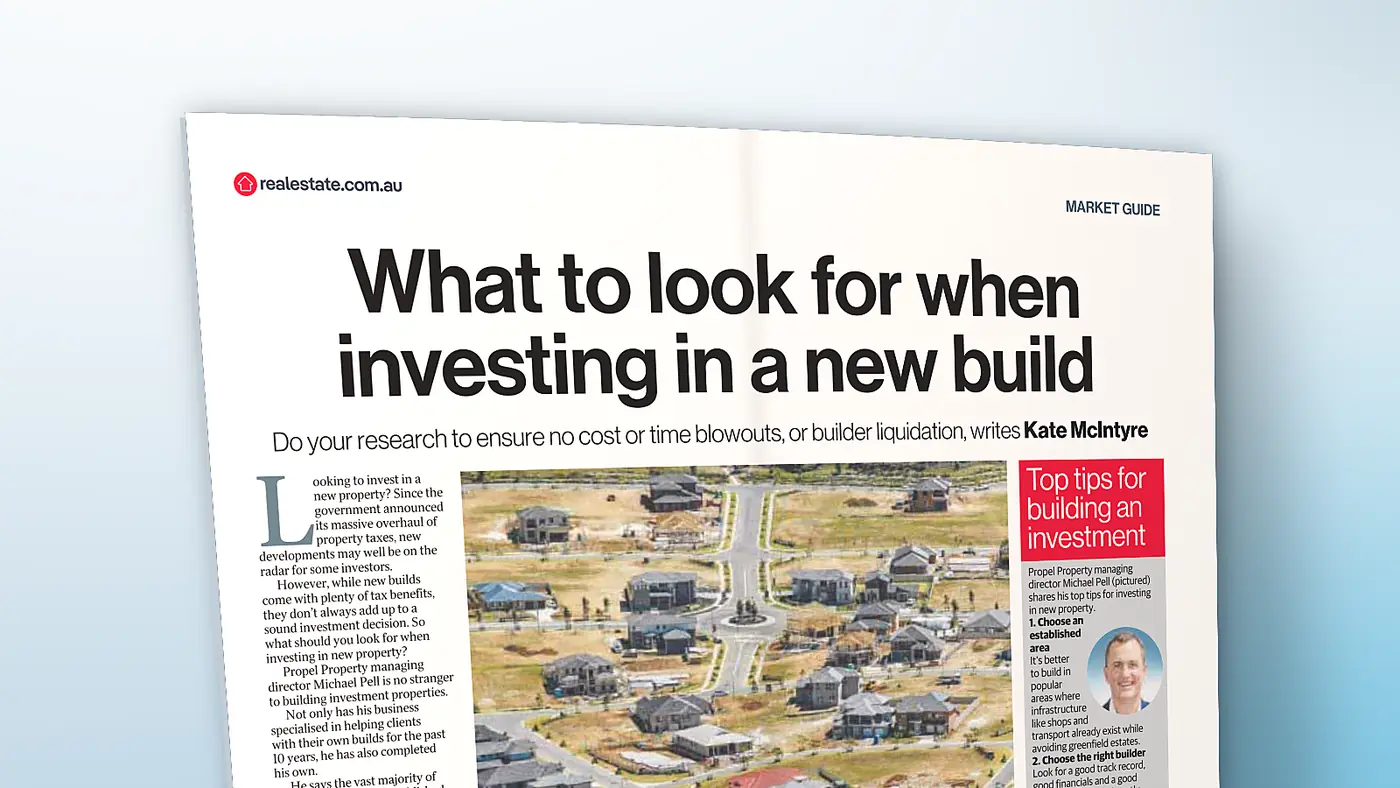
Kate McIntyre has published a piece in realestate.com.au exploring some of the pitfalls investors can encounter when choosing to build rather than buy established. I contributed to the article from an investment perspective. Here is a short summary of the issues it raises and why they matter.
The article brings together two different perspectives on new-build investment. Propell Property Managing Director Michael Pell provides the builder perspective, drawing on ten years of managing client builds as well as his own experience, while I look at the investment considerations and the importance of getting the fundamentals right.
It is a practical piece and worth reading in full. Below, I have expanded on some of the key issues investors should consider when assessing a new-build opportunity.
Start with the location, not the builder
The fundamentals of good property investment do not change when it comes to building. The location still needs scarcity of housing, strong demand, economic growth behind it and a solid demographic of owner occupiers. Buying for the tax benefits alone should be avoided.
A new build changes the tax profile of an asset. It does not change whether the asset was worth owning.
Get the strategy right and understand that first. Make sure you are looking at understanding the fundamentals of the location, the asset and how that is going to achieve what you want for your strategy.
Richard Crabb, realestate.com.auMichael raises a related point that is worth separating out. House and land packages are not the problem many investors assume they are. The difficulty is usually the greenfield estate around them, where supply arrives all at once and there is nothing scarce about the stock.
The contract is the property
You cannot walk through a house that has not been built. The building contract is therefore the only reliable description of what you are buying, and it deserves the attention you would otherwise give a physical inspection.
Provisional sums are the first thing to look for. Michael identifies them as the most common place costs run away from investors, because they are allowances rather than fixed prices and they move once construction is under way.
Specification is the second. A build has to make sound economic sense, but there is a difference between building efficiently and building cheaply. Laminate in place of stone, and lower ceilings, are decisions that surface later in what the property is worth to the next buyer.
We both caution against relying on display homes. They are built to the highest specification a builder offers because their purpose is to sell. Previous completed builds are a far better guide to what you will actually receive.
Know what your warranty covers
The structural guarantee should be set out in the building contract. As a general rule you would expect a three to six month warranty covering all the works, then a structural guarantee running six years or longer depending on the state.
These are two separate protections and they are often treated as one. The first covers the finish. The second covers the frame, the slab and the elements holding the building up. Most disputes land in the gap between them.
Apartments add a further layer. In a large complex your outcome depends on a strata you share with hundreds of other owners and on the quality of a building you did not commission. Who built it, what their track record is and what happened to their previous projects are not optional questions.
Why off the plan sits differently
Buying a block and building is not the same decision as buying an apartment off the plan, and the two are often discussed as though they are.
If you buy land and build, you settle the land early and you own an asset from that point. If you buy off the plan, your deposit buys the right to settle at completion. You do not own the property in the meantime, and a one to three year window is long enough for the market, your borrowing capacity or the developer to change.
What I would add
None of this is an argument against building. In the right location, with a builder who holds costs and a contract that says what it means, a build can be an efficient way to execute a strategy and to manufacture equity along the way.
The point is the order of the decisions. Establish the strategy first, then test whether a build is the right way to deliver it. Every investor's position is different, and the key is applying the right strategy at the right time.
For readers who want the longer version, I set out the contract, warranty and off the plan issues in more detail when the piece first ran in print: investing in a new build, the strategy has to come first.
As featured in
Property experts reveal the biggest pitfalls to avoid with new build investments
Written by Kate McIntyre. The same feature ran in the Herald Sun Market Guide on Saturday 8 August 2026, page 29.
Read the full article on realestate.com.auRichard Crabb was interviewed as CEO of ASPIRE Property Advisor Network and Vice Chairman of the Property Investment Professionals of Australia, alongside Propell Property Managing Director Michael Pell.
Test the location before you test the builder
If a new build is on your shortlist, the most valuable work happens before a contract is signed. Whether building suits your position depends on your goals, your timing and your borrowing capacity.
ASPIRE does not provide advice directly. We accredit independent property advisors and hold them to a professional standard, then connect investors with the advisor best suited to their position.