

Investing in a new build starts with the strategy
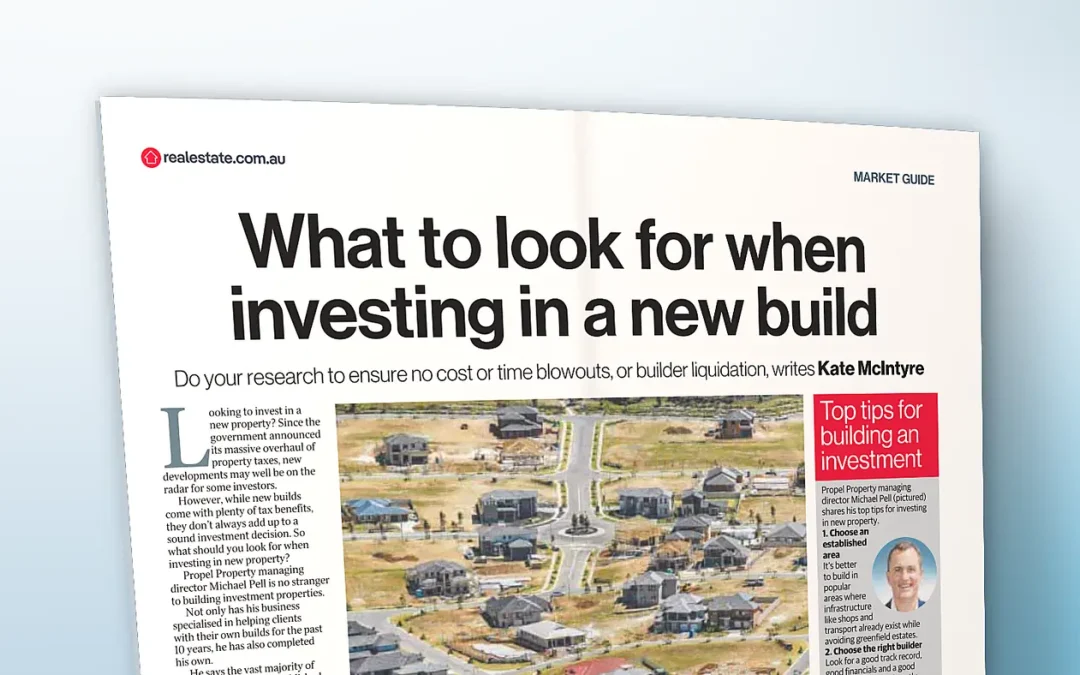
Kate McIntyre's feature in the Herald Sun Market Guide asked whether investing in a new build makes more sense than buying an established property. I contributed to the piece alongside Propell Property Managing Director Michael Pell.
Under the new negative gearing rules, new builds carry a tax advantage over established residential property bought after the May 2026 cut-off. Investors who had not considered them before are looking again. That advantage lowers the cost of holding the property. The location and the demand behind it still decide how it performs.
Pell covered the practical side of building. His advice included choosing a builder who finishes on time and holds to cost, watching for provisional sums and keeping a cash buffer through construction. The sections below set out the decisions that sit underneath that advice.
Fundamentals still decide performance
The new negative gearing rules start on the 1st of July 2027 and cover established residential property bought after 7.30pm AEST on the 12th of May 2026. A net rental loss on such a property can then be offset only against income and capital gains from residential property, with any excess carried forward. Property already held at the May 2026 cut-off keeps its current treatment, and new builds can still be negatively geared.
A new build still has to sit where housing is scarce and demand is strong. It needs economic growth behind it and owner occupiers who will compete for it at resale. Those conditions decide whether a property performs, whether it was built last year or in 1978.
What a new build changes is the tax and maintenance profile, and both are secondary. Depreciation improves the holding position on a property that was always going to perform, and it cannot rescue one that was not. Buying for tax benefits alone should be avoided.
The strategy has to be settled first. Whether a new build is the right way to deliver it is the second question. Some investors reverse that order and decide to build before looking for somewhere to do it. The land that is easiest to find is rarely the land with the strongest demand behind it.
Reading the contract as the inspection
An established property can be inspected for its ceiling heights, finishes, orientation and light. With a build, the contract is the property, so it deserves the same attention a physical inspection would receive.
The contract should show what is included and which items are allowances rather than fixed prices. It should specify the ceiling heights, joinery, flooring and external finishes. It should also show where site costs sit and who carries them if ground conditions differ from what was assumed.
Display homes are built to the highest specification a builder offers, because their purpose is to sell. Recently completed homes are a better guide, ideally ones the builder did not choose to show.
Specification sets the resale value
When a budget tightens during a build, the finishes usually change first. Laminate replaces stone, ceiling heights come down and a cheaper window package goes in.
Each change looks small on a spreadsheet. Together they set the limit on what the property is worth to the next buyer and to the valuer. A home that presents as the cheapest version of itself in a street of better finished homes will sell for less, and depreciation does not make up the difference. The build has to make economic sense, which is a different test from being the lowest price.
What the builder's warranty covers
Warranty protection comes in layers, and each state sets its own. In New South Wales, the builder's own defects and liability period for a new home is usually 13 weeks. Separately, the Home Building Act 1989 sets statutory warranties, with six years from completion to start proceedings for a major defect and two years for any other defect.
In Victoria, action for a breach of the statutory building warranties can be taken up to ten years after the occupancy permit or certificate of final inspection is issued. In Queensland, proceedings generally must start within six years for a structural defect and one year in any other case.
Many of the disputes advisors across our network see turn on the difference between these layers, or on whether the builder is still trading when a claim is made. Where a state requires home warranty insurance, it is a further protection for that second risk, and its cover and thresholds differ between states. The new-build pitfalls article sets out other risks to check.
- Read the warranty provisions before signing the contract.
- Check whether home warranty insurance applies in your state and what it covers.
- Confirm your position if the builder stops trading before the home is finished.
Why off the plan carries different risk
Building on land you own and buying an off the plan apartment are often treated as the same decision. When you build, you settle the land early and own an asset from that point. When you buy off the plan, you pay a deposit and hold the right to settle on completion.
That difference matters if values move, if your borrowing capacity changes before completion or if the developer does not finish. Apartments add a further layer. In a large complex your result depends on the strata, the decisions of the other owners and the quality of a building you did not commission. The builder's track record and the history of their previous projects should be checked before any deposit is paid.
How investors are approaching new builds
Advisors across our network are speaking with investors who have moved from established property to new builds largely on the tax argument. Some have not tested whether the locations now in front of them meet the standard they applied before. New stock is concentrated where land is available, and land is often available where demand is thinnest. Policy change tends to shift behaviour faster than it shifts fundamentals, a point made when capital gains tax settings came under review.
Build risk also deserves careful pricing. Fixed price contracts, shorter build programs and builders with sound financials are worth paying for, and the lowest tender rarely produces the lowest final cost.
Good new-build opportunities do exist. They sit in established areas with infrastructure already in place, where the location has shown it can hold value. New or established compares the two in more detail.
Steps before investing in a new build
The points above on location, construction and tax lead to three practical steps, taken in this order.
- Test the location on its likely demand over the next ten years, including planned new supply and the depth of owner occupier buyers at resale.
- Check how the property fits the portfolio you already hold and how long you plan to keep it, including whether you can carry the costs through construction.
- Work through the numbers before any tax benefit is applied, so depreciation and negative gearing improve a purchase that already stands on its own.
A new build is one way to deliver a property strategy, and whether it suits yours is your decision. The right answer depends on the properties you already hold, your finances and the plan you have set for them. An Accredited Advisor can test a new build against your goals, timeframe and tolerance for risk. Your advisor works alongside the licensed professionals your situation requires, so each part of the decision rests on evidence about your own position.
Data sources
- Herald SunKate McIntyre, What to look for when investing in a new build, Herald Sun Market Guide, the 8th of August 2026, page 29, published online by realestate.com.au on the 20th of August 2026.
- NSW GovernmentBuilder's defects and liability period: NSW Planning Portal, MyHome Planner, post build. Statutory warranty periods under the Home Building Act 1989: NSW Government, Contracts for residential building work.
- Consumer Affairs VictoriaStatutory building warranty period: Consumer Affairs Victoria, Building problems after property settlement.
- Queensland Building and Construction CommissionStatutory warranty periods: Queensland Building and Construction Commission Act 1991, Schedule 1B, section 29, as set out in the QBCC Consumer Building Guide.
- Australian Taxation OfficeNegative gearing change: Treasury Laws Amendment (Tax Reform No. 1) Act 2026, which received Royal Assent on the 26th of June 2026, as summarised by the ATO, Tax reform: reforming negative gearing and capital gains tax.
General information only, current at the 9th of November 2026. This article does not take into account any individual's objectives, financial situation or needs and does not constitute financial, credit, taxation or legal advice. ASPIRE Property Advisor Network supports independent accredited property advisors and does not provide taxation or financial product advice. Borrowing capacity should be confirmed with a mortgage broker, taxation positions with a registered tax agent and contract terms with a solicitor or conveyancer.
Test a new build before signing
ASPIRE Accredited Advisors hold the PIPA Qualified Property Investment Adviser qualification and work without conflicts of interest. They can apply the points in this article to your own properties and goals.
Accredited Advisors follow the ASPIRE and PIPA Codes of Conduct, complete annual professional development and hold a real estate licence and professional indemnity insurance.
Be Connected With An Accredited Advisor