
Media & Commentary
Investing in a new build: the strategy has to come first
Kate McIntyre put a straightforward question to the industry in Saturday's Herald Sun Market Guide. If you are buying residential property as an investment, does a new build stack up against an established one? Here is the fuller discussion behind my comments.
Kate McIntyre's Market Guide feature in Saturday's Herald Sun asked something a lot of investors are working through right now. New builds carry real tax advantages. Do they carry a better investment case?
It is a fair question. With property tax settings back in the national conversation, new developments have moved onto the radar for investors who had not seriously considered them before. The tax profile of a brand new asset looks attractive on paper. Whether that makes it a sound investment decision is a separate question, and the gap between those two things is where most of the risk sits.
I contributed to the piece alongside Michael Pell of Propell Property, who covered the practical ground well. Choose a builder who finishes on time and holds costs. Watch for provisional sums. Keep a buffer through the construction period. What follows is what sits underneath all of that.
The fundamentals do not change because the house is new
A property still has to sit where housing is scarce and demand is strong. It still needs economic growth behind it and a demographic of owner occupiers who will compete for the asset when you sell. Those conditions decide whether the property performs. Whether it was built last year or in 1978 does not change them.
What a new build changes is the tax profile and the maintenance profile, and both are secondary. Buying for tax benefits alone should be avoided. Depreciation improves the holding position on an asset that was always going to perform. It cannot rescue one that was not.
Get the strategy right and understand that first. Then work out whether a new build is the right vehicle to deliver it.
Richard Crabb, Herald Sun Market GuideA lot of investors run that order backwards. They decide to build, then go looking for somewhere to do it. The land that is easiest to find is rarely the land with the strongest fundamentals behind it.
You cannot walk through a property that does not exist
With an established property you inspect it. You see the ceiling heights, the finishes, the orientation and the way light moves through the place. With a build, the contract is the property.
For this reason the building contract deserves the same attention you would give a physical inspection. What is genuinely included. What is an allowance rather than a fixed price. What the specification says about ceiling heights, joinery, flooring and external finishes. Where site costs sit, and who wears them if ground conditions are not what was assumed.
Display homes are not a reliable guide. They are built to the highest specification a builder offers because their job is to sell. Ask to see completed builds instead. Recent ones, and ideally ones the builder did not choose for you.
Specification is a resale decision, not a budget decision
When a budget tightens during a build, the finishes move first. Laminate replaces stone. Ceiling heights come down. The cheaper window package goes in.
Each decision looks small on a spreadsheet. Together they set the ceiling on what the property is worth to the next buyer and to the valuer. A property that presents as the cheapest version of itself in a street of better finished homes will not achieve the same result, and no amount of depreciation makes up the difference. The build has to make sound economic sense, which is not the same as being cheap.
Know what the warranty actually covers
Under a standard building contract you would typically expect a defects period of three to six months covering all the works, then a structural guarantee running six years or longer depending on the state.
The two are not interchangeable. The defects period covers the finish. The structural guarantee covers the frame, the slab and the elements holding the building up. Most of the disputes advisors across our network see fall in the gap between them, or turn on whether the builder is still trading when the claim is made.
- Read the warranty provisions before you sign, not after handover.
- Check which statutory home warranty insurance applies in your state, because cover and thresholds differ.
- Confirm what happens to your position if the builder ceases trading mid contract.
Apartments and off the plan carry a different risk profile
Building on a block you own and buying an off the plan apartment are often discussed as the same decision. They are not.
If you build on land, you settle the land early and you own an asset from that point. If you buy off the plan, you place a deposit and you own nothing until completion. What you own in the meantime is the right to settle. That matters if the market moves, if your borrowing capacity changes, or if the developer does not finish.
Apartments add a further layer. In a large complex you are tied to the strata, so your outcome depends on decisions made by hundreds of other owners and on the quality of a building you did not commission. Who built it, what their track record is and what happened to their previous projects are not optional questions.
What we are seeing on the ground
The tax conversation is doing more work than it should in the decision. Advisors across our network are speaking with investors who have shifted from established property to new builds largely on the tax argument, without reassessing whether the locations now in front of them meet the same standard they applied before. New stock is concentrated where land is available, and land is often available where demand is thinnest. Not always, but often enough to check every time. We made a similar point when capital gains tax settings came under review, because policy change shifts behaviour faster than it shifts fundamentals.
Build risk is also being priced more carefully than it was three years ago, and that is healthy. Fixed price contracts, shorter build programs and builders with clean financials are worth paying for. The cheapest tender is rarely the cheapest outcome.
There are good new build opportunities. They sit in established areas with infrastructure already in place, where the location has proven it can hold value and the numbers work before the tax benefit is applied. The opportunity sits in being selective rather than being early.
The strategic takeaway
A new build is a delivery method. It is not a strategy.
The strategy is the location, the asset type, the holding position and the role property plays in the portfolio you are building over the next fifteen or twenty years. Once that is settled, building can be an efficient way to execute it, particularly where you can control the specification and manufacture equity through the process. Run it the other way around and you end up owning a very new house in a place that was never going to work.
The questions worth asking about a new build are the same questions worth asking about any investment property. Where is it. Who wants to live there. What does demand look like in ten years. And does the deal make sense before the tax treatment is applied. Every investor's position is different, and the key is applying the right strategy at the right time. This is about making informed decisions rather than reacting to a change in policy settings.
As featured in
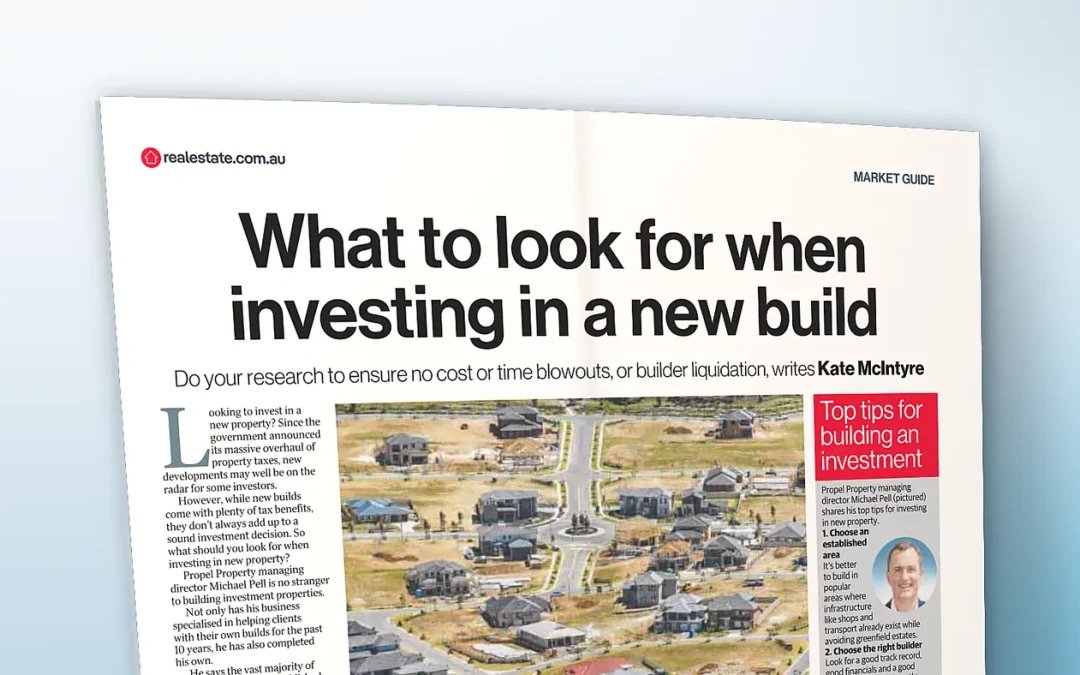
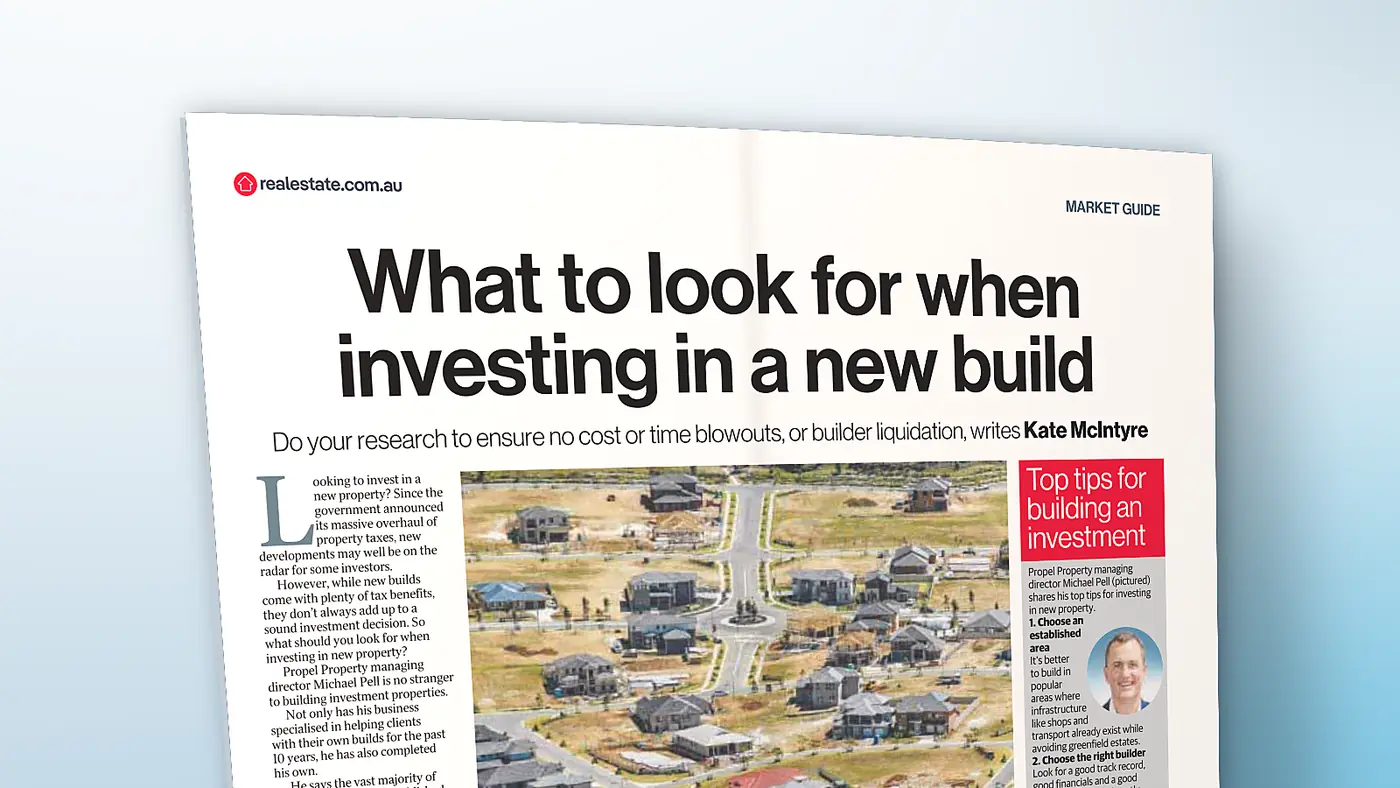
What to look for when investing in a new build
Kate McIntyre, Market Guide, Herald Sun, Saturday 8 August 2026, page 29. Published online by realestate.com.au on 20 August 2026.
Read the full article on realestate.com.auRichard Crabb was interviewed as CEO of ASPIRE Property Advisor Network and Vice Chairman of the Property Investment Professionals of Australia, alongside Propell Property managing director Michael Pell.
Test the location before you test the builder
If a new build is on your shortlist, the most valuable work happens before a contract is signed. Every investor's position is different, and whether building suits yours depends on your goals, your timing and your borrowing position.
ASPIRE does not provide advice directly. We accredit independent property advisors and hold them to a professional standard, then connect investors with the advisor best suited to their position.