
Many capable people intend to invest in property for years and never start. The delay rarely comes from a considered decision to wait. It comes from the absence of a process that turns an intention into a decision they can test, act on or deliberately set aside.
This article looks at why that stall happens, what it actually costs, and the order of steps that moves an investor from thinking about property to a decision made on evidence.
Why capable people stall
Three patterns appear again and again in conversations across our network. The first is complexity. Property investment touches lending, tax, law, research and negotiation at once, and a person who is expert in their own field can reasonably feel out of their depth in all five.
The second is information overload. Free content is everywhere, much of it contradictory, and a great deal of it is produced by people paid when a property is sold. Reading more rarely resolves the uncertainty and usually adds to it.
The third is the absence of a sequence. Without an agreed order of steps, every question appears to depend on every other question, so nothing can be settled first. The investor waits for a clarity that never arrives on its own.
Policy uncertainty adds to the delay. The Property Investment Professionals of Australia 2026 Annual Investor Sentiment Survey found that 87.2% of investors are not confident future governments will keep property tax settings stable. The concern is reasonable, and it is also an easy reason to postpone a decision indefinitely.
Doing nothing is still a decision
Choosing not to act is legitimate when it follows a proper assessment. Drifting is different, because it carries costs that are easy to overlook. Time is the most obvious: years spent deciding are years in which a sound asset could have been held, and in which the investor is growing older with a shorter runway. Preparation is the second: an investor who has not organised finance, structure and strategy cannot respond when a suitable property appears. The third is the quality of later decisions. People who eventually act after a long delay often do so in a hurry, under pressure from a rising market or a persuasive marketer, which is precisely when mistakes are made.
No one can promise what any property will be worth in future, and waiting may sometimes prove the better choice. The real cost of drift is that the choice is never actually made. Waiting is a sound choice when it follows an assessment of the facts.
Preparation comes before property
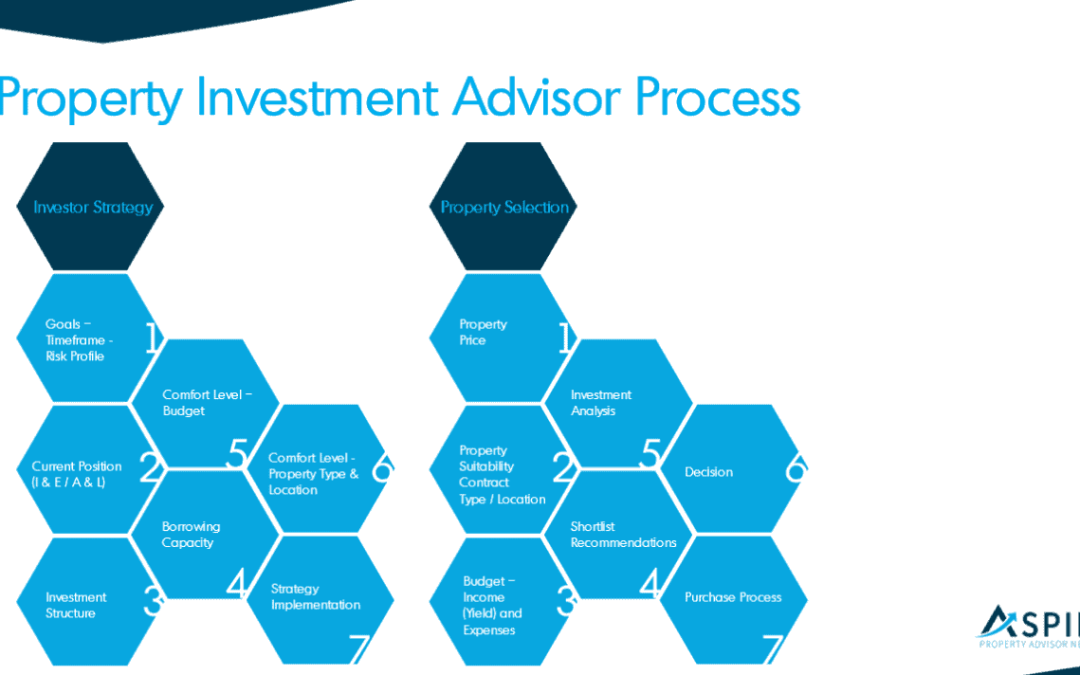
The ASPIRE 15 step pathway is organised into four phases: Review, Plan, Act and Ongoing Review. The first two phases account for around 60% of the work, and none of it involves choosing a property. The Review phase confirms the engagement, completes a detailed fact find covering position, goals, constraints and risk, and sets the due diligence framework. The Plan phase reviews scenarios for outcomes, funding, exit and risk, reviews any existing portfolio, finalises the strategy and produces an asset brief that states exactly what the purchase must achieve.
Only then does the Act phase begin. That order is the remedy for analysis paralysis, because each step settles one set of questions before the next is opened. An investor who reaches the asset brief knows what they are looking for and why, which makes the search itself far shorter. The property strategy advisory service describes how Accredited Advisors run these phases.
Confirm your funding position with a mortgage broker first
Borrowing capacity is the boundary of every other decision, and it has changed this year. The cash rate has risen four times in 2026 to 4.60%, lenders still assess new loans at least three percentage points above the loan rate, and APRA now limits how much lending each bank can write at six times income or more. A mortgage broker can confirm what you can borrow and arrange pre-approval, so the figure is a fact rather than an estimate. That conversation belongs with a licensed broker; ASPIRE does not provide credit advice.
Ask your accountant about structure and tax before signing
Whether a property is bought in your own name, jointly, through a trust or in a company affects tax, borrowing, estate planning and flexibility for decades. The negative gearing and capital gains tax changes that start on the 1st of July 2027 make that advice more important, not less, because the treatment now depends on when and what you buy. These are questions for your accountant, and the answers should be in hand before a contract is signed, when changing the ownership is still free.
Set a budget you can hold comfortably
A lender's maximum is the most a bank will lend, not the amount you should spend. Set your own limit by asking what you could commit each month for five years if rates rose again and the property sat vacant for a few weeks. Investors who buy within that limit can hold a sound asset through a soft market; those who stretch to the maximum are the ones most often forced to sell at the wrong time. The guide to deciding whether now is the right time sets out a simple holding test.
Set a review date and choose
Once the preparation is done, put a date in the diary and make one of three decisions.
- Proceed. Finance is confirmed, the structure is settled and the strategy is written. The search can begin against a clear brief.
- Prepare. One element is missing, such as savings for a deposit or a decision on structure. Name it, set a deadline and review again.
- Pause. The assessment shows that buying now does not suit your circumstances. Record why, and set the conditions that would change the answer.
Each outcome is a decision made on evidence, which is the point. Australian Taxation Office statistics for 2023-24 show that 2,335,540 people held an interest in a rental property. Of those, 71.6% held a single property and only 1.7% held five or more. The difference between those who build a portfolio deliberately and those who stop after one, or never begin, is rarely income. It is usually process.
Where to start
If you have been meaning to start for some time, the most useful first step is a conversation, not a search. An ASPIRE Accredited Advisor acts for you rather than for a developer, vendor or agent, and works through the Review and Plan phases before any property is discussed. For background reading, the ASPIRE property investment guide explains the full process, and how to recognise a property spruiker covers the pressure that often follows a long delay.
Turn the intention into a decision
An Accredited Advisor can take you through the Review and Plan phases, so that whether you proceed, prepare or pause, the choice is made on evidence.
General information only, current at the 28th of October 2026. It does not take account of your objectives, financial situation or needs. Property investment involves risk. Speak with a mortgage broker about finance, an accountant about tax and ownership structure, and a solicitor or conveyancer about any contract before acting. ASPIRE does not provide credit, tax, legal or financial planning advice.